Building a Green Future: The Sustainable Logic and Practice of Foldable Structures
Industry Background: Carbon Reduction Pressure and Traditional Dilemmas under ESG Standards
As Environmental, Social, and Governance (ESG) metrics become deeply integrated into the core of corporate decision-making, especially with the increasingly strict scrutiny on carbon emissions across supply chains and value chains, the construction industry is facing unprecedented pressure to reduce its carbon footprint.
For a long time, traditional temporary site facilities, represented by color-steel sandwich panel houses, have brought irreversible ecological burdens. After one or two project cycles, they often suffer severe dismantling damage and are reduced to tons of scrap metal and sandwich panel waste, ultimately ending up in landfills.
In contrast, Foldable Container Houses offer a highly forward-looking alternative, establishing a true circular economy model for temporary infrastructure.
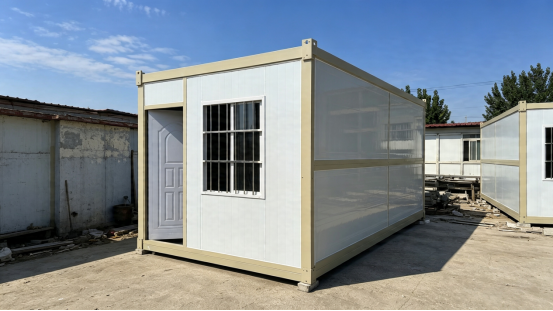
The sustainable advantages of this structure are validated throughout the project's life cycle by a series of specific operational data:
1、Logistics: Extreme Space Compression and Emission Reduction
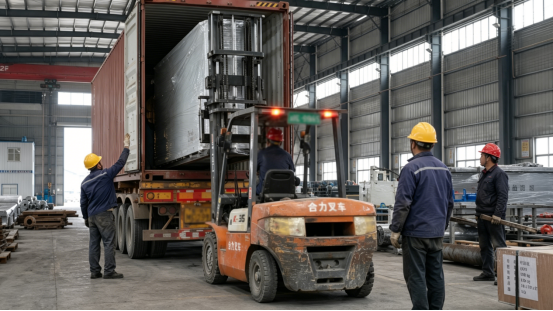
Through innovative hinges and a flat-pack design, the volume of a Folded Container House can typically be compressed to one-fourth to one-fifth of its expanded state. This means that a standard heavy flatbed truck, which could originally only carry 2 sets of traditional container houses, can now transport 8 to 10 folded units in a single trip. This not only significantly cuts logistics costs but also directly reduces transport carbon emissions per square meter of usable building space by approximately 75%.
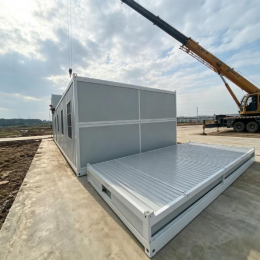
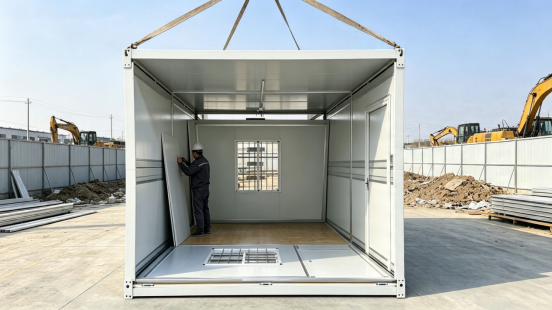
Upon arrival at the site, thanks to millimeter-level factory prefabrication, the installation of Foldable Structures bids farewell to traditional cutting, welding, and wet construction. Requiring only one crane and two workers, a unit can typically be expanded and secured into place within 15 minutes. This non-destructive assembly process completely eliminates the offcuts, dust pollution, and packaging waste common in traditional construction sites, truly achieving zero-waste construction.
3、Daily Operations: High-Standard Materials Build a Low-Energy Barrier.
In actual use, high-quality Foldable Units are no longer simple "tin boxes." Their walls are typically standard-equipped with flame-retardant polyurethane (PU) or high-density rock wool insulation, complemented by double-glazed windows and doors. This high-performance building envelope effectively insulates against severe cold and heat, significantly reducing power consumption for heating and cooling in remote site dormitories and offices, thereby cutting the operational carbon footprint at the source.
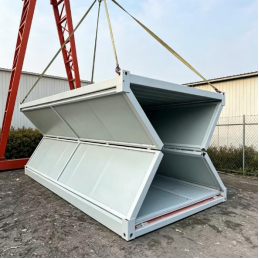
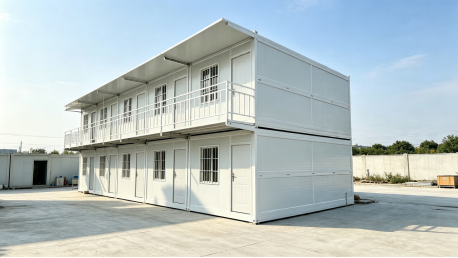
However, the most significant ecological dividend of Foldable Structures lies in the "longevity" attribute endowed by cross-cycle reuse. Traditional temporary buildings may deform or even be scrapped after two or three cycles of assembly and disassembly. In contrast, industrial-grade Foldable Container Houses utilize a high-strength steel main frame, with a design life typically reaching 10 to 15 years, capable of withstanding dozens of repeated foldings and hoistings.
After project completion, these facilities do not require destructive dismantling. Instead, they can be quickly folded, transported with low carbon emissions, and seamlessly transitioned to the next construction section, or even cross-industry transformed into emergency rescue command posts or outdoor camps.
Strategic Height: Empowering Corporate Sustainable Development Visions
This innate recyclable gene resonates highly with the core concepts of the circular economy. For companies committed to fulfilling ESG promises and publishing high-quality sustainability reports, the saved waste disposal volumes and carbon emissions can all be translated into solid green data in their reports.
Adopting Foldable Structures is no longer limited to operational considerations of cost reduction and efficiency enhancement for a single project; it is a strategic declaration showcasing corporate environmental responsibility and addressing strict carbon audits. It proves through real-world scenarios: in the future construction ecosystem, efficient infrastructure deployment and strict environmental responsibilities are by no means a zero-sum game, but two pillars that complement and empower each other.
——Conclusion: Reshaping the Green Infrastructure of the Future
In summary, Foldable Structures are not only practical tools for dealing with environmental compliance pressures but also the inevitable result of the construction industry moving towards standardization and sustainability. It sends a clear signal to the global market: true long-termism is the deep integration of excellent modular manufacturing processes with environmental responsibility.
Relying on a life-cycle carbon reduction logic and highly efficient cross-border logistics advantages, Foldable Structures are completely breaking the geographical limitations of traditional infrastructure, turning "greener buildings" from an ESG blueprint on paper into a tangible reality around the world.